|
The Al Aqsa Flood of October 7th, 2023 brought the Oslo era to a close.͏ ͏ ͏ ͏ ͏ ͏ ͏ ͏ ͏ ͏ ͏ ͏ ͏ ͏ ͏ ͏ ͏ ͏ ͏ ͏ ͏ ͏ ͏ ͏ ͏ ͏ ͏ ͏ ͏ ͏ ͏ ͏ ͏ ͏ ͏ ͏ ͏ ͏ ͏ ͏ ͏ ͏ ͏ ͏ ͏ ͏ ͏ ͏ ͏ ͏ ͏ ͏ ͏ ͏ ͏ ͏ ͏ ͏ ͏ ͏ ͏ ͏ ͏ ͏ ͏ ͏ ͏ ͏ ͏ ͏ ͏ ͏ ͏ ͏ ͏ ͏ ͏ ͏ ͏ ͏ ͏ ͏ ͏ ͏ ͏ ͏ ͏ ͏ ͏ ͏ ͏ ͏ ͏ ͏ ͏ ͏ ͏ ͏ ͏ ͏ ͏ ͏ ͏ ͏ ͏ ͏ ͏ ͏ ͏ ͏ ͏ ͏ ͏ ͏ ͏ ͏ ͏ ͏ ͏ ͏ ͏ ͏ ͏ ͏ ͏ ͏ ͏ ͏ ͏ ͏ ͏ ͏ ͏ ͏ ͏ ͏ ͏ ͏ ͏ ͏ ͏ ͏ ͏ ͏ ͏ ͏ ͏ ͏ ͏ ͏ ͏ ͏ ͏ ͏ ͏ ͏ ͏ ͏ ͏ ͏ ͏ ͏ ͏ ͏ ͏ ͏ ͏ ͏ ͏ ͏ ͏ ͏ ͏ ͏ ͏ ͏ ͏ ͏ ͏ ͏ ͏ ͏ ͏ ͏ ͏ ͏ ͏ ͏ ͏ ͏ ͏ ͏ ͏ ͏ ͏ ͏ ͏ ͏ ͏ ͏ ͏ ͏ ͏ ͏ ͏ ͏ ͏ ͏ ͏ ͏ ͏ ͏ ͏ ͏ ͏ ͏ ͏ ͏ ͏ ͏ ͏ ͏ ͏ ͏ ͏ ͏ ͏ ͏ ͏ ͏ ͏ ͏ ͏ ͏ ͏ ͏ ͏ ͏ ͏ ͏ ͏ ͏ ͏ ͏ ͏ ͏ ͏ ͏ ͏ ͏ ͏ ͏ ͏ ͏ ͏
|
Yesterday marked thirty-one years since the signing of the Oslo Accords, a series of agreements between the Palestinian Liberation Organization and Israel promising a path towards a two-state solution — a path that that led nowhere, was hugely unpopular among Palestinians, and left the talons of Zionism in Arab lands. After Oslo, Palestine became a closed case in the global geopolitical arena as settlements expanded in Gaza and the Occupied West Bank; Zionist expansionism sealed with a handshake between Israeli Prime Minister Yitzhak Rabin and PLO leader Yasser Arafat. This betrayal, this “Palestinian Versailles,” as Edward Said famously called it, extinguished the flame of the First Intifada, the popular uprising that began in Jabalia refugee camp in northern Gaza in 1987 and shook the region until the Oslo “Peace Process” of 1993. The death of four Palestinians in a car crash with an Israeli vehicle in Jabalia sparked the First Intifada — but the groundwork for the uprising, the structure that ensured its sustenance, was set down by a group of women over the prior decade. Beginning in 1978, women’s committees proliferated across the occupied lands: the Women’s Action Committees, the Working Women’s Committees, the Union of Women’s Committees, and the Women’s Committee for Social Work. These groups operated under the guise of “social work,” running nurseries and putting on sewing and cooking workshops. “That was all window dressing,” said Naima Al-Sheikh Ali in the film Naima and the Uprising, a documentary about Palestinian women’s role in the First Intifada. “In reality, and covertly, it was all political organizing.” As “Israel” killed and imprisoned thousands of Palestinian men in street protests, women took up the political work, mobilizing within villages and refugee camps to call for a boycott of “Israeli” goods and to assist agricultural workers in becoming financially independent from the occupation. When the Zionists shut down schools and universities, the committees developed an “underground network of popular education,” transforming Palestinian society into “a field of experimentation in non-formal and informal” learning. By the early nineties, Arafat had spent a quarter of a century in exile and was largely removed from the work of the women’s committees and the street protests of the Intifada. Oslo was, then, an attempt to regain control over a people mobilizing of their own accord, an uprooting of the popular resistance boiling over in Palestine, a resistance anchored in the political work of Palestinian women. Its lessons instruct us to this day: any government that normalizes “Israeli” statehood or collaborates with the Zionists is no representative of the Palestinian people, who demand not an amputated nation but a return to the whole of their lands, from the river to the sea. Was this email forwarded to you? Sign up to get it in your inbox.
|
“The truly astonishing proportions of the Palestinian capitulation”
|
|
The last 31 years have proven Oslo’s prescient dissenters right. They included Marxist and Islamist factions, militants, and poets. Mahmoud Darwish quit the PLO in protest; His friend Edward Said published a London Review of Books essay, “The Morning After,” castigating the agreement. He wrote: The fashion-show vulgarities of the White House ceremony, the degrading spectacle of Yasser Arafat thanking everyone for the suspension of most of his people’s rights, and the fatuous solemnity of Bill Clinton’s performance, like a 20th-century Roman emperor shepherding two vassal kings through rituals of reconciliation and obeisance: all these only temporarily obscure the truly astonishing proportions of the Palestinian capitulation.
The grand betrayals of Oslo fall neatly into three parts. The first: To begin negotiations, the Palestinian Liberation Organization recognized “Israel” and its right to exist, and renounced “terrorism.” In accepting this framing, Arafat acquiesced to the conflation of “terrorism” with resistance against an occupier and appeased the Zionist entity at the expense of the full national liberation of mandate Palestine. “Far from being seen as the victims of Zionism,” Said wrote, “the Palestinians were characterised before the world as its now repentant assailant.” The second: An agreement made in the Accords to form the Palestinian Authority to govern East Jerusalem, as well as the West Bank and Gaza. Said foresaw that the organization would become “Israel’s enforcer,” presiding over permanent economic dependency. The third: the division of the West Bank into three separate administrative zones determining government control, civilian control, and security rights. This set the legal and political stage for today’s West Bank, where over half a million settlers have divided Palestinians into a series of incongruous islands separated by a labyrinth of militarized checkpoints. Arafat, Said notes, had never even seen those settlements metastasizing throughout the West Bank up close. Perhaps his only mistaken prediction was that some of the smaller settlements might “wither away.” Not a single one was uprooted in the years since Oslo. A Palestinian gendarmerie now watches supine as more and more land disappears, and punishes its own people for challenging the theft. Yasser Arafat banned Edward Said’s books after his LRB essay appeared. You can probably find a copy of Orientalism in Ramallah these days, but you will not find much respect for the Palestinian Authority, ruled by a president who makes Joe Biden look vivacious. “Much more important than having a state,” Said argued, “is the kind of state it is.” Said blamed this “instrument of Palestinian surrender” on the self-serving isolation of the PLO leadership. They failed to advance the rupture created by the First Intifada. After rejecting negotiations for years, they reversed course from a position of abject weakness. The same Yitzhak Rabin who described Israeli policy during the intifada as “might, power, and beatings” got to enjoy his new peacemaker image. The rhetorical consequences of the agreement were also devastating, and must be resisted. The Oslo Accords inaugurated a lexicon for discussing Palestine which replaced the language of the Palestinian struggle for national liberation with frameworks of global civil society and international human rights law that cast Palestinians as victims in need of relief from international civil society, rather than protagonists who can (and will) liberate themselves. This shift prioritized voices and political philosophies of Western academia and civil society over Palestinians in Palestine. The heroic Al Aqsa Flood of October 7th, 2023 brought the Oslo era to a close. As we approach one year of unbroken and fearless resistance to the Zionist entity in Palestine and across the globe, it is necessary at all times to be vigilant against normalization and capitulation and steadfast in our conviction that Palestine and Palestinians will see liberation.
|
Lessons from this week’s other anniversary
|
|
The United States used 9/11 to justify a grotesque expansion of state surveillance programs and political repression. New initiatives targeted Palestinian, Sikh, Arab, and Muslim communities across the United States, monitoring mosques, civil society organizations, student groups, schools, and private homes. Muslims and those perceived as Muslim also encountered hate crimes and violence stoked by the state, the United States media, and Zionist groups. But these forms of terror were not borne out of 9/11. Just as the Zionist entity and imperial war profiteers test their most savage weapons on Palestinians in Gaza, so too did they pioneer their invasive and repressive programs of surveillance and repression on Palestinian activists earlier than even the 1970s. The long history of anti-Palestinian and anti-Arab racism in the United States shows us that the tactics tested on Palestinians in Palestine and abroad will always be used against other insurgent peoples and movements. Our struggles are connected and the Palestinian resistance serves as a beacon to all those resisting imperialism across the world.
|
Fight repression, defend language
|
|
WAWOG stands with all culture workers who refuse to aid in the normalization of Zionism, often risking their jobs, careers and professional reputations to stand with Palestine. If you are experiencing repression in the workplace, email rapid-response@wawog.com and a member of our newly formed anti-repression task force will reply to you within 24 hours. We have followed with particular concern the recent case of a Powerhouse Books worker whose principled choice to cancel an event that featured a Zionist—it was a conversation with the author Joshua Leifer, moderated by the pro-Israel rabbi Andy Bachman—resulted in her being fired and publicly disparaged by her former employer. As writers and readers, we should be horrified by the perversions of language which allow the mere naming of Zionism to be categorized as hateful, and which further justify backlash against those defending the Palestinian cause. As avowed anti-Zionists, we should be proud of our commitment to life. Booksellers in New York City are forming a coalition to strategize against workplace retaliation and media backlash. To join, email pacbi@wawog.com with “booksellers” in the subject line.
|
|
...and the halls, the campuses, the sidewalks, the parks, the highways, the trade routes. Come together to fight U.S.-led imperialism. Mark your calendars, comrades. October 5 has been named the International Day of Action to commemorate one year of struggle, one year in a long history of Palestinian resistance. Find an action near you or plan one. There are already actions scheduled in Dallas, Seattle, Boston, Austin, Indianapolis, Houston, Montreal, Toronto, Ottawa, Vancouver, the DMV, Orlando, LA, NYC and Providence. Join the people in the streets and show the world the end of Zionism is not just possible, but inevitable. As we approach October 7, 2024, keep going. Reflect on what strategies worked this year at your job, in your community, at your school. Read Palestinian writers. Talk to your neighbors. Refuse the normalization of violence against Gaza, East Jerusalem, and the Occupied West Bank. Most importantly, get outside for the International Day of Action. Commune. Organize. Imagine, together. Fuck things up, together. Collective action is the conduit for Palestinian liberation.
|
Support the New York War Crimes
|
|
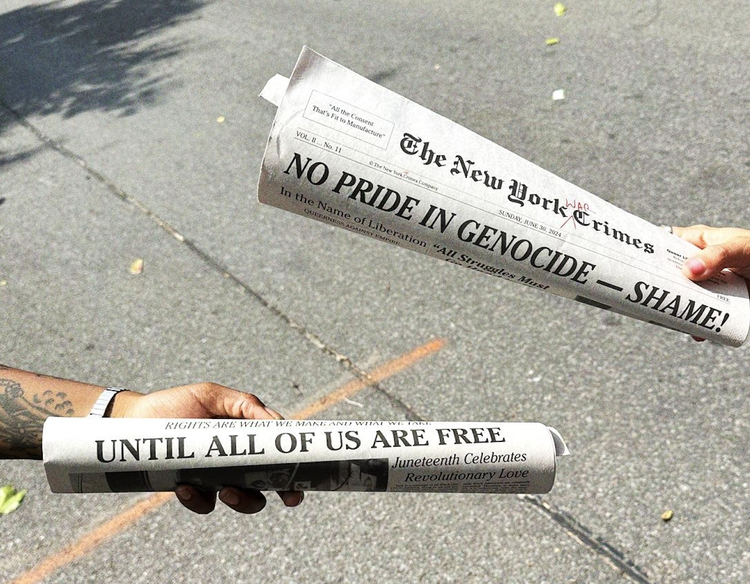
Continuing in the tradition of Gran Fury's The New York Crimes, which covered what the so-called “paper of record” ignored and obfuscated during the AIDS crisis, The New York War Crimes has produced thirteen issues to date. The paper has printed the names of Gaza's martyrs, reprinted seminal historical texts, and published new essays, interviews, poems, and translations. Every issue can be read at newyorkwarcrimes.com.
Our next issue will be the longest yet, commemorating a year of genocide and a year of resistance. The issue will feature new prose, poetry, and photographers from contributors on the ground in Gaza and the West Bank alongside newly translated works by Refaat Alareer, Walid Daqqa, Mahdi Amel, and more. We will also publish statements from our movement partners, including National Students for Justice in Palestine, the Palestinian Youth Movement, and the Palestinian Campaign for the Academic & Cultural Boycott of Israel. This will be the first issue to be printed and distributed outside of New York. Cities currently on our distribution list are: Boston, Philadelphia, Toronto, Los Angeles, the Bay Area, Chicago, Detroit, Houston, Dallas, Sāo Paulo . The money raised for this issue will cover all printing costs and provide honorariums to contributors in Gaza and the West Bank. Any funds raised over our goal will be donated to the Palestinian Journalists Syndicate.
|
|
We leave you with a statement from Khalida Jarrar, writing from HaSharon prison on International Women's Day in 2016 On this day, we affirm that we are Palestinian prisoners of struggle, and part of the Palestinian women’s movement, and that the national and social struggle goes on constantly and continuously until we win our freedom from occupation, and our freedom as women from all forms of injustice, oppression, violence and discrimination against women. On this day, Palestinian women mark this occasion in light of the crimes of the occupation against Palestinian women, children, elders and youth. This year, our call focuses on the freedom and self-determination of our people, and the freedom and self-determination of Palestinian women: achieving equality and liberation, and ending all forms of oppression and injustice committed against them. We stand as part of a global struggle with all the world’s women freedom fighters: against injustice, exploitation and oppression.
|
Until liberation,W.A.W.O.G.Twitter: @wawog_now Instagram: @wawog_now For press inquiries: press@wawog.com For general inquiries: wawog@wawog.com Was this email forwarded to you? Sign up to receive it here.
|
|
1) Funeral in Kafr Ni'ma during the First Intifada. Photograph by Joss Dray, ca. 1988. 2) Photograph of the Apartheid wall in Ramallah ca. 2004 by Justin McIntosh. 3) Photograph of the artist Agnes Denes's Wheatfield—A Confrontation: Battery Park Landfill (1982). 4) Palestinian Youth Movement demonstration in Toronto, May 15, 2021. Photograph by Steve Russell. 5) WAWOG photograph of the New York War Crimes’ Pride and Juneteenth issues. 6) Image taken from Martin Ginestié's "In Defense of the Rocket" (2015), a documentary short about the rise and fall of the so-called peace process.
|
|
|
|