|
We support the Palestinian’s just struggle for liberation one hundred percent. ͏ ͏ ͏ ͏ ͏ ͏ ͏ ͏ ͏ ͏ ͏ ͏ ͏ ͏ ͏ ͏ ͏ ͏ ͏ ͏ ͏ ͏ ͏ ͏ ͏ ͏ ͏ ͏ ͏ ͏ ͏ ͏ ͏ ͏ ͏ ͏ ͏ ͏ ͏ ͏ ͏ ͏ ͏ ͏ ͏ ͏ ͏ ͏ ͏ ͏ ͏ ͏ ͏ ͏ ͏ ͏ ͏ ͏ ͏ ͏ ͏ ͏ ͏ ͏ ͏ ͏ ͏ ͏ ͏ ͏ ͏ ͏ ͏ ͏ ͏ ͏ ͏ ͏ ͏ ͏ ͏ ͏ ͏ ͏ ͏ ͏ ͏ ͏ ͏ ͏ ͏ ͏ ͏ ͏ ͏ ͏ ͏ ͏ ͏ ͏ ͏ ͏ ͏ ͏ ͏ ͏ ͏ ͏ ͏ ͏ ͏ ͏ ͏ ͏ ͏ ͏ ͏ ͏ ͏ ͏ ͏ ͏ ͏ ͏ ͏ ͏ ͏ ͏ ͏ ͏ ͏ ͏ ͏ ͏ ͏ ͏ ͏ ͏ ͏ ͏ ͏ ͏ ͏ ͏ ͏ ͏ ͏ ͏ ͏ ͏ ͏ ͏ ͏ ͏ ͏ ͏ ͏ ͏ ͏ ͏ ͏ ͏ ͏ ͏ ͏ ͏ ͏ ͏ ͏ ͏ ͏ ͏ ͏ ͏ ͏ ͏ ͏ ͏ ͏ ͏ ͏ ͏ ͏ ͏ ͏ ͏ ͏ ͏ ͏ ͏ ͏ ͏ ͏ ͏ ͏ ͏ ͏ ͏ ͏ ͏ ͏ ͏ ͏ ͏ ͏ ͏ ͏ ͏ ͏ ͏ ͏ ͏ ͏ ͏ ͏ ͏ ͏ ͏ ͏ ͏ ͏ ͏ ͏ ͏ ͏ ͏ ͏ ͏ ͏ ͏ ͏ ͏ ͏ ͏ ͏ ͏ ͏ ͏ ͏ ͏ ͏ ͏ ͏ ͏ ͏ ͏ ͏ ͏ ͏ ͏ ͏ ͏ ͏ ͏ ͏
To strugglers everywhere,Yesterday, hundreds of thousands of us around the world rallied for Land Day, an annual commemoration and continuation of the Palestinian peoples’ struggle against the zionist entity’s theft of their soil, their crops, their olive trees, their homes. The tradition began in 1976, with a general strike and mass protests against the “Israeli” state for its plan to confiscate 20,000 dunams (about 5,000 acres) of land in the Galilee; and it continues with the greatest urgency today. Over the past several weeks, the zionist entity has escalated its sadism in the Gaza Strip. Occupation forces have besieged hospitals, inflicting tortures on those inside. They have buried young men with armored bulldozers. They have assaulted young women. While “Israeli” citizens block aid trucks from entering southern Gaza, the “Israeli” state bars UNRWA from delivering to the north. They are starving children to death. These stories and images have cleaved our hearts and reinforced our commitment to Palestinian liberation. We root ourselves in the teachings of revolutionary thinkers and fighters like Bassel al-Araj, who inspired a generation of young Palestinians to reject the Palestinian Authority, a surrogate for the zionist occupation, and reignite the spirit of the First Intifada; and like George Jackson, who argued from his cell in California’s Soledad Prison that Black people are historical prisoners of war. Both revolutionaries were assassinated by state forces — al-Araj by “Israeli” police and Jackson by “American” prison guards. In Tip of the Spear, the book we are all reading (are you?), Orisanmi Burton describes the 1971 Attica prison revolt as “a people’s war, a counter-war” waged against a “carceral siege.” The Palestinian resistance is likewise engaged in what Black revolutionary Robert F. Williams called “a guerrilla war of self-defense” against the world’s most militarized occupier. The Black liberation movement has always held a radical internationalist politic, and an unwavering solidarity with the Palestinian struggle is part of its revolutionary legacy. Our predecessors and movement ancestors knew that the Black and Palestinian struggles were kindred spirits. We have seen and felt these junctures in the streets where, as in the George Floyd uprising of 2020, protests have been met with escalating repression, including kettling and beatings by the NYPD. We also know that “Israel” and the U.S. share strategies for the surveillance of Muslims, the criminalization of Black and Brown people, and the repression of Indigenous-led movements. The blueprint for Cop City in Atlanta derives from the zionist entity’s “Little Gaza,” a military training base in an-Naqab, the so-called “Negev,” in 2006. “Israel’s” Cop City was built on stolen Palestinian land, and the proposed site of Georgia’s Cop City is the Weelaunee Forest, 381 acres of stolen Muscogee land — land that became a plantation in the 19th century and a prison farm in the 20th. Borne out of decades of Black-led abolitionist organizing, the Stop Cop City movement is a Land Back movement, too. In this edition of the WAWOG Bulletin, we explore these connections and advance our collective struggle.
|
Find sameness in resistance
|
|
The following is adapted from a speech given by a member of our Philadelphia chapter.
When George Jackson, author of Soledad Brother: The Prison Letters of George Jackson, was murdered by prison guards in 1971, they discovered 99 books in his cell. Entry number 93 — between Ralph Ellison’s Invisible Man and The Nature of Democracy, Freedom and Revolution by Herbert Apthaker — is Enemy of The Sun: Poetry of Palestinian Resistance (1970). Here is a stanza from the titular poem in Enemy of the Sun: You may take the last strip of my land,
Feed my youth to prison cells.
You may plunder my heritage.
You may burn my books, my poems
Or feed my flesh to the dogs.
You may spread a web of terror
On the roofs of my village,
O enemy of the sun,
But I shall not compromise
And to the last pulse in my veins I shall resist.
The Black Panther Party’s newspaper printed the poem, crediting the lines to Jackson himself. In fact, the poem was written by a Palestinian, Samih al-Qasim. What this case of mistaken credit exposes is the truth of identification and of comradeship, signifying the parallels between the conditions of being Black in America and being Palestinian under occupation, the depth of the connections between these struggles. We can do more to expose these connections. We can talk, for example, about the eerie likeness between the US police and “Israeli” military: the way they brutalize Black and Palestinian people, killing them with impunity, trading tactics on how best to murder and maim.
We can talk about incarceration: how Black people face a different criminal court than their white counterparts, while Palestinians living under apartheid face a military court that convicts them at a rate of 99%; settlers face civil courts for the same crimes. Incarceration is mobilized by both the US and the zionist entity as counterinsurgency. In America, Black revolutionaries including Mumia Abu-Jamal, Russell Maroon Shoatz, and Assata Shakur have all had varied yet similarly brutal experiences with incarceration. West Philly activist and educator Ant Smith, is serving a one year sentence in prison for flipping an insured cop car during the 2020 uprising. In a similar fashion, political dissidents in the West Bank are incarcerated for Facebook posts and protests; the number of arrests in the occupied West Bank increased from 5,000 to 12,000 in the last six months.
|
We can talk about the similarities between the militarized neighborhoods in Philadelphia and Palestine. How, in 2020, when protests erupted in West Philly, police and national guard created checkpoints on 52nd Street similar to the checkpoints that fragment Palestinian villages in the occupied West Bank, in full violation of international law and Palestinian sovereignty.
We can talk about how the tear gas that was deployed on Philadelphia protests on I-676 is the same tear gas used against Palestinians in the occupied West Bank. |
|
|
|
|
We can also just talk about the reality that Black/Palestinian solidarity exists simply because Afro-Palestinians exist both here in the US and in Palestine. As legal scholar and professor Noura Erakat has said, “Black people the world over have suffered from a legacy of racism much deeper than the contemporary Palestinian struggle.” But the point is not to compare oppression. To quote a comrade, “Solidarity is not sameness in oppression. Solidarity is sameness in resistance.”
Indeed, we must look no further than 2020, with the largest US mobilization against the police and anti-Blackness. Over 26 million people flooded the streets in response to the horrific murders of Breonna Taylor and George Floyd, culminating in the inferno of the third Minneapolis police precinct. On October 7th, the water of the Al-Aqsa flood broke through the walls confining the people of the Gaza Strip.
Our comrades in prison, both here and in Gaza, have proven time and time again that they will not be passive in the face of monstrous violence.
On September 9, 1971, inmates at the Attica Prison rose up against oppressive, despicable conditions. Occupying half of the prison, they presented a list of demands including medical care, adequate visits, the right to form labor unions, and an end to police brutality. In 2020, at the height of the COVID-19 pandemic, prisoners erupted in mass protest to demand PPE, better health and safety precautions, and compassionate release for the sick and elderly. In 2021, six Palestinians broke out of a high-security zionist prison by digging themselves a tunnel using only spoons. The year after that, Hisham Abu Hawash ended a 141-day hunger strike to protest being in administrative detention without charge. He was released. And right now, in Gaza, the largest open-air prison in the world — without food, water, electricity, or fuel — Palestinians are marching through the streets, even during a genocide, refusing to leave their homes, chanting, “Death over humiliation.”
Wherever people are incarcerated, brutalized, and stripped of their freedom — there will always, always be resistance. These pieces of shared history show that the Palestinian struggle has always been an abolitionist one, that the abolitionist struggle will always be an anti-zionist one.
|
Learn the history of Afro-Palestinians
|
|
This is an excerpt from a profile of Sheikh Mousa Qous for the Eyewitness Palestine newsletter. Eyewitness is an organization that brings people to see Palestine and the devastation of the “Israeli” occupation. The executive director of the organization has produced a documentary about the experience of Afro-Palestinians, Black in the Holy Land, which is set to be released later this year. Watch the trailer here, and donate to support the good work of Eyewitness Palestine here. Like many Black Palestinians, Sheikh Mousa was born in Jerusalem. Conservative estimates put Jerusalem’s Afro-Palestinian population between 350-400. Most of them, Sheikh Mousa says, can trace their ancestors to four African countries: Chad, Nigeria, Sudan, and Senegal. According to Sheikh Mousa, most Afro-Palestinians either ended up in Palestine for humanitarian reasons “or for religious reasons. After performing pilgrimage to Saudi Arabia, many of them also perform pilgrimage in Jerusalem. If they go back to their countries of origin, this pilgrimage gives them higher status in society, because they visited and prayed at the holiest sites of Islam. Some decided to stay in Jerusalem.” He goes on, “Some [Africans] came to Palestine for humanitarian reasons. They came to help Palestinians by joining Arab forces to fight for the liberation of Palestinian lands that were taken by Zionists.” Today, Jerusalemite Afro-Palestinians live predominantly in a part of the Old City that has become known as the African Quarter. It was originally built by the Mamluk Empire, which ruled Palestine in the 13th century. The quarter was intended to house both the impoverished and pilgrims who needed shelter while carrying out religious duties in Jerusalem, according to Sheikh Mousa. He goes on to explain that, towards the end of their reign in Palestine, the Ottomans decided to convert the compound into a prison, which was later shut down under British colonial rule. Sheikh Mousa says that because of where Black Palestinians are situated in Jerusalem, they are often at the forefront of attacks by illegal Jewish settlers. Despite being targeted by settlers and Occupation Forces, Afro-Palestinians continue to resist and live their lives as proud Palestinians. Yet, often when people ask the Occupation Forces that loom in the Old City about where the Afro-Palestinian quarter is, they are told that such a quarter does not exist. Sheikh Mousa chalks this up to a denialist attitude about Palestinians in general. “Of course we exist, and we are Palestinian.”
|
Free Palestine. Stop Cop City!
|
|
This is a dispatch from a Stop Cop City comrade and organizer in Atlanta, Georgia. Stop Cop City is a movement to prevent the construction of a facility for the Atlanta Police Department to practice putting down mass uprisings by killing people. We know they wanted to build it with enough room to set off bombs next to a youth detention center in a predominantly Black neighborhood; this area has experienced chronic flooding since construction began. We know this is about death because they killed Manuel “Tortuguita” Teran to build it. Currently, dozens are being charged with domestic terrorism, and police have raided the homes of five opponents to the facility. The state has arrested John “Jack” Mazurek and accused him of setting fire to motorcycles, holding him without bond and or proper food. They indicted him before we were able to see the results of an appeal. Scalawag, Atlanta Community Press Collective, and The New Inquiry have published pieces about the connections between Stop Cop City Movement and the veritable resistance in Palestine. These pieces all touch on the Georgia International Law Enforcement Exchange exchange program, which dates back to 1992. They all point out that Gaza City was designed to help “Israeli” occupying forces practice killing Palestinians. Even so, we see people misunderstand “ceasefire” the same way they misunderstood “abolish the police.” Both of these struggles reveal what happens when we realize that appeals to the non-existing morals of our oppressors will always fail. “I am proud to say that our thin blue line stretches across the Atlantic Ocean to the State of Israel,” one of Atlanta’s top cops has said — publicly.
We’ve run down all the facts, but do we have a radical understanding of what revolution means? Do we have a radical understanding of who needs to die and therefore who bears the responsibility of revolt? The benefit of being in Atlanta is that we can see the current genocide in Palestine for what it is: a canary in the coal mine. If American cities are beefing up policing and repression, they are preparing to kill us, and the question that remains is whether we will allow them to when the time comes. The function of radicality is the simplification of truth. Press conferences with state officials, appeals to moral high ground, and marketing lingo all hide our responsibility and put off our radicalization; meanwhile, the state improves its fighting capability. But when the homes that get raided are places you once attended dinner parties, when the people the cops kill are folks you know from organizing meetings, when you lose financial footing, when you go to jail for what you shared on Instagram, when the water is no longer potable, when the police kill more and more (2023 was deadliest year for police killings on record in both the US and Palestine), there will be less room to hide from the responsibility to revolt.
|
|
Palestine is an abolitionist struggle. In the world’s largest open-air prison, Palestinians are subject to militarized policing, imprisonment, administrative detention, surveillance and other death-dealing carceral techniques. The IOF exports surveillance technologies, drones, and other weapons around the world. Abolitionists understood the resonances between Black and Indigenous people long before the Ferguson-Gaza solidarities that began in summer 2014. Zionist settler-colonial conquest, too, can also be understood within a long history of imperialism, colonialism, and slavery.
Abolition is not a single-issue politics. Everything is connected, everything is affected. What is there to abolish, besides everything? By abolitionist, the meanings are multiple, varied, and even sometimes conflicting: some mean abolish the police, abolish prisons, abolish the conditions that seem to require prisons, abolish the little cop in your mind. Some mean abolish states, abolish borders, abolish property, abolish authoritarianism, abolish organizations. Abolish all forms of colonialism, abolish slavery, abolish sexual violence, abolish capitalism, abolish anti-Blackness.
The collective revolutionary movement known as abolition is grounded in the uprisings against the transatlantic slave trade and its afterlives. Abolition is also an international fight that can only be understood in a long, broad and capacious sense, accounting for centuries of racial-colonial genocide, environmental disaster, slavery, imperialism, and conquest. To say “Free Palestine” is to also see Palestinian freedom fighters as part of a planetary struggle for liberation.
|
|
The global criminalization of Black people is connected to the criminalization of Palestinians, but it is not synonymous. This solidarity cannot be transactional. Some Black radicals in the US supported Zionism in 1948 (connected to issues of Pan-Africanism and/as Black zionism). As Palestine began to be more thoroughly understood as an anti-imperial, anti-colonial, anti-racist and anti-capitalist revolutionary struggle, important shifts transpired. We must contend with that difficult history just as much as we must contend with Arab and Palestinian anti-Blackness.
On the African continent, resources are ravaged and pillaged by corporations and governments. Anti-Blackness is indeed global. The criminalization and dehumanization of Blackness is evident in all corners of the world, as demonstrated by the treatment of African asylum seekers. In September 2023, Netanyanhu called for the deportation of African migrants in “Israel,” calling them “illegal infiltrators.” Abolition, one learns, is a practice, and it points us also to the multiple genocides occurring: in Congo, Myanmar, Sri Lanka, and elsewhere.
Recently, we watched Aaron Bushnell set himself on fire outside of the zionist entity’s consulate in Washington, DC. His last words were “Free Palestine.” This past November, it was reported that a man in the capital of the DRC set himself on fire. Engulfed in flames, he died holding a sign that said, “Stop the genocide in Congo.” In December, a woman set herself on fire with a Palestinian flag outside the zionist entity’s consulate in Atlanta. We still don’t know her name. Those in power try to bury these stories, but the people remember and honor them. We recognize, too, Mohamed Bouazizi, whose self-immolation in 2010 became a touchstone in the Arab Spring. And Thích Quảng Đức, the Vietnamese monk whose self-immolation protest was well-circulated in a 1963 image. Two years later, an inspired antiwar activist and Quaker Norman Morrison set himself on fire at the Pentagon to protest the U.S.’s devastating actions in the Vietnam War. Glory to their resistances, which are our resistances. There were others. There are others. Will we hear their calls?
|
Get your news from the Panthers
|
|
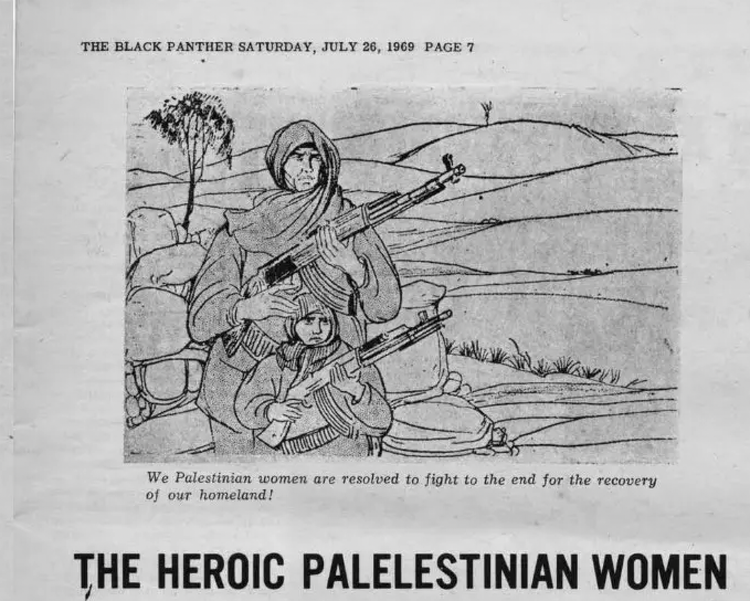
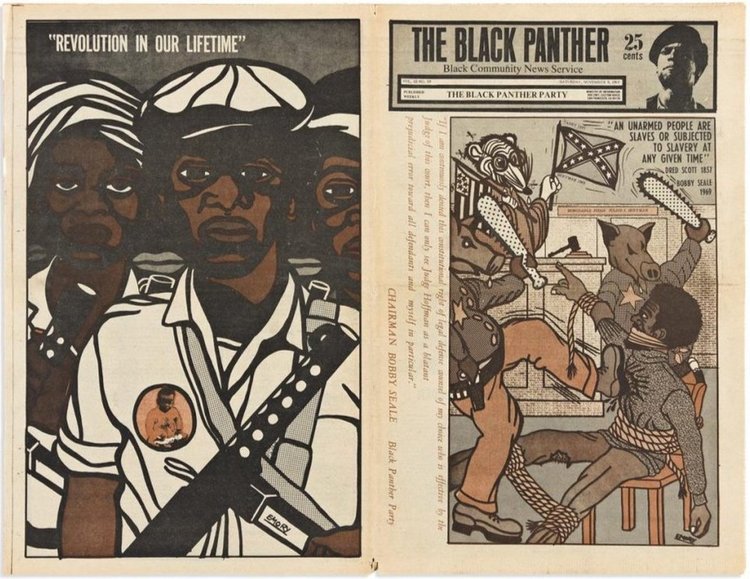
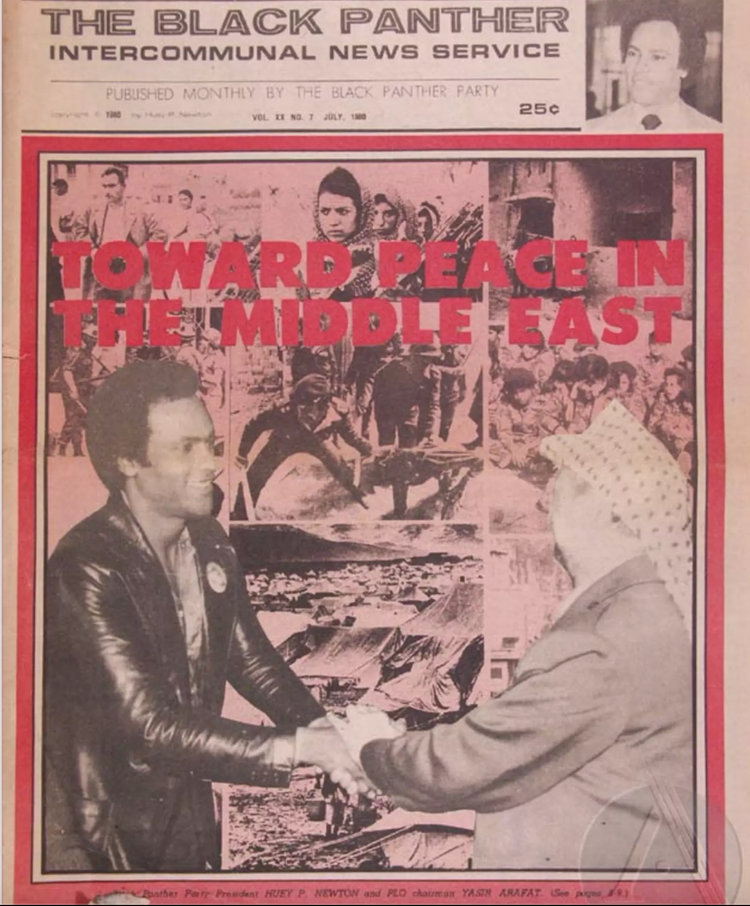
The Black Panther Intercommunal News Service (INS) was a weekly periodical launched by the Black Panthers in April 1967. Featuring news analysis by BPP members and art by Emory Douglas, information about the party’s political activities, and adorned with the newspaper, at its peak, sold 300,000 copies a week.
Notably, the periodical contextualized white supremacy, anti-Blackness, imperialism, and capitalism within a larger internationalist framework. Each issue featured at least one article, if not an entire section, on the struggles against colonial domination in the global south. In 1970, the BPP issued its first statement in solidarity with Palestine, stating that they “support the Palestinian’s just struggle for liberation one hundred percent. We will go on doing this, and we would like for all of the progressive people of the world to join in our ranks in order to make a world in which all people can live.”
|
|
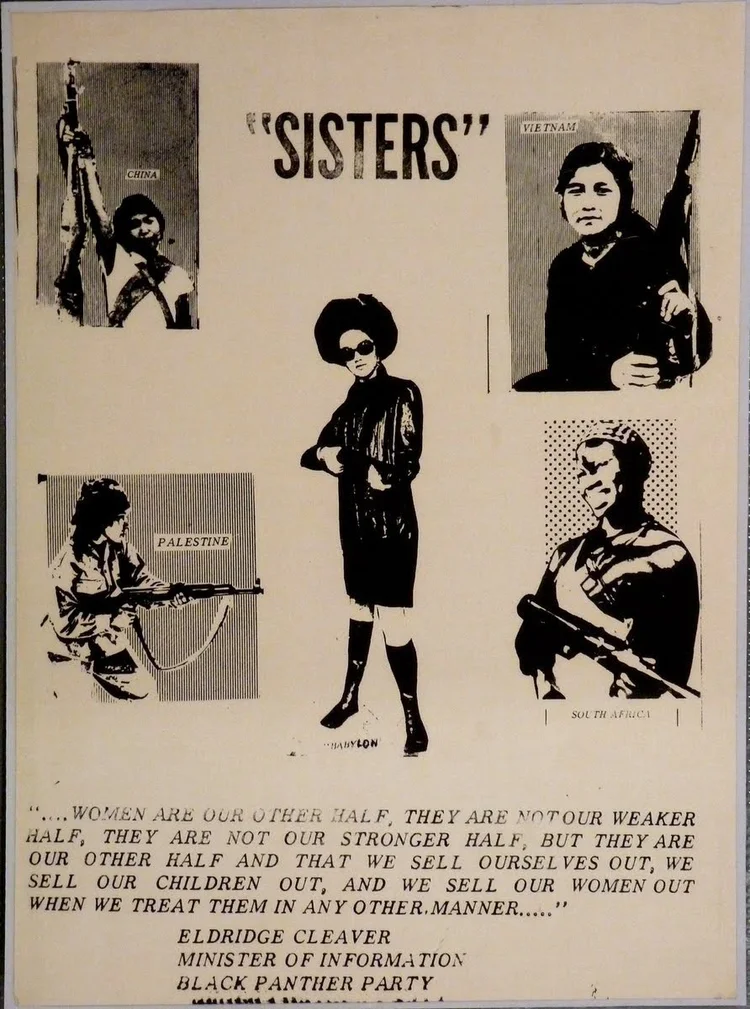
Over the course of two decades, the newspaper highlighted the heroic efforts of Palestinian women who not only picked up arms but raised children to be the next generation of resistance to the zionist occupation, illustrated the international character of resistance in Vietnam, China, Palestine, South Africa, and America, printed statements of Yasser Arafat and the Palestinian Liberation Organization (PLO), delineated the solidarity that formed amongst the global south, and mapped the similarities in state tactics of counterinsurgency and repression via prisons and police. |
|
|
|
The paper ended in 1982 with the collapse of the Black Panther Party. The archive lives; it demands your time.
|
Get a copy of the New York War Crimes
|
|
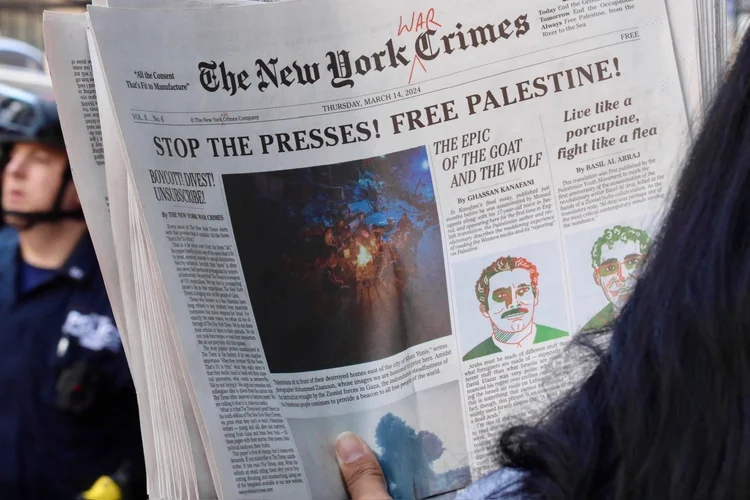
Ten thousand copies of the sixth issue of the New York War Crimes were distributed across New York City on Thursday, March 14, as part of a coordinated set of actions targeting the New York Times Company. (For more about those actions, which together comprised the largest-ever demonstration against the Times, please see coverage in Hellgate, AJ+, or Democracy Now, or go to our Instagram page.)
The New York War Crimes is for the people and free of charge. This issue is filled with the voices of Palestinians from Gaza, the Occupied West Bank, and the diaspora—perspectives long suppressed by the Times.
Digital versions of all six issues to date are available for download at our new website, newyorkwarcrimes.com. If you are interested in printing and/or distributing the paper outside of New York, please write to now@wawog.com.
|
Register for the People’s Conference for Palestine
|
|
The Palestinian Youth Movement is hosting a conference in Detroit from May 23 to 26. The event will include keynotes, plenary discussions, workshops, and art & cultural activities. Learn more on the conference website.
|
|
What’s new in WAWOG? A lot, so here are some highlights: The PACBI Committee reports that more than 100 cultural organizations have now committed to the Palestinian Campaign for the Academic and Cultural Boycott of “Israel.” Please welcome our newest endorsers, from BGSQD to Topos Books to Capricious Publishing, into the explicitly anti-zionist cultural front we’re working daily to build. Care to join? Send us an email: pacbi@wawog.com. The Labor Committee has been working with local unions and other coalitions of workers to organize within a variety of industries, assess the state of unions in their support for Palestinian liberation, and apply pressure for stronger stances in support of ceasefire, retracting endorsements of President Biden, and divesting from industries involved in the occupation. The group has been part of labor contingents in rallies across the country and is helping organize a worker’s march in Philadelphia. To get connected, write to labor@wawog.com. Our Toronto chapter is part of a coalition of writers, artists, and culture workers standing strong against Scotiabank, the largest individual foreign shareholder in the “Israel” weapons manufacturer Elbit Systems. To find out more about the No Arms in the Arts campaign, or to get involved, write to toronto@wawog.com. Finally, we in the Communications Committee urge you to keep boycotting, divesting, and unsubscribing from the New York Times. Use our email template to write letters to the editors responsible for the utter failure of ethics that is “Screams Without Words,” and, if you don’t mind, cc us at now@wawog.com when you do. Then, donate the money you’re saving by not condoning lies to a family in Gaza.
|
Aid Wars, by Dylan Saba Towards an Intellectual History of Genocide, by Esmat Elhalaby Becoming Monsters: What Happens When the Victim Becomes the Defendant, by Islam Al-Khatib Palestine is in Asia, by Viet Thanh Nguyen As Journalists Are Murdered in Gaza, Their Counterparts Lose Jobs in America, by Steven W. Thrasher Journalism as a Front of War: On American Media and the Ideology of the Status Quo, also by Steven W. Thrasher Against Artwashing, by members of Art Not Genocide Alliance Leslie Feinberg to Aswat: ‘I am at your side’ The Customs of Obedience in Academe, by Steven Salaita In Gaza you can witness what the end of the world will look like, by Hudia Who Are My People?, by Trina Jackson No Human Animals: On Black Solidarity with Palestine and the Defense of Life, by Robyn Maynard Imprisoning Palestine, by Rawan Masri & Fathi Nemer Yes, I said “National Liberation,” by Robin D.G. Kelley Free Palestine. Stop Cop City, by the Palestinian Youth Movement Almost 5 months in, organizers for a ceasefire and free Palestine aren’t backing down, by Laura Weiss Sinan Antoon’s The Corpse Washer Issue 3 of Hammer and Hope
|
|
WAWOG’s writing group meets Monday, Wednesday and Friday at 11 AM EST on Zoom. We write together, and then we talk together. To receive the Zoom login information and/or join our Signal chat, email writers@wawog.com.
|
The Bassel al-Araj essay “Live Like a Porcupine, Fight Like a Flea” was first translated into English by the Palestinian Youth Movement in 2018, one year after al-Araj’s assassination at the hands of “Israeli” police. Palestinian and Levantine life, al-Araj wrote, had adapted to the shape of the odd, quilled rodent: “It only wanders around at night; lonely and solely contemplating, getting attracted to smells, to fruits, and roots. […] Though it can wail, it is lonely; its pain is deep, but its grudge is deeper still—just as it is with its hunter.” |
|

|
|
|
Resistance, on the other hand, is best approached in the style of the opportune, ineradicable parasite, which “stings, jumps and stings again avoiding hands or feet trying to stomp it…what it does is exhaust its host and consume its blood, causing constant disturbance, eventually preventing the host from being able to rest. It makes the host nervous and demoralized.” The efficacy of each creature is embodied in their lack of encounter — porcupines rarely have fleas (testament to its offensive evolution), while the flea, undaunted by being denied one host, leaps to another. Battle, of course, unfolds on multiple fronts, from the physical to the informational to the rhetorical. Wresting the narrative and discursive reins out of enemy hands is one purpose of the New York War Crimes project, which is now online at newyorkwarcrimes.com.
|
|
As Che Nieves, a veteran of the Attica rebellion, said to Orisanmi Burton: “We need each other. It’s not only me, but you. That’s what keeps us going. Exchange, it keeps the spirit going, and it keeps us moving toward freedom. The more you acquire, the more I acquire. And without you, it’s not me. You make me and I make you.”
In sameness,W.A.W.O.G.Twitter: @wawog_now Instagram: @wawog_now For press inquiries: press@wawog.com For general inquiries: wawog@wawog.com
|
|
IMAGE CREDITS: 1—4) Black Panther Intercommunal news service. 5) Photograph by Julia Sharpe-Levine. 6) Photograph by Hannah La Follette Ryan. 7) Phote by Daniel José Older, taken at a Land Day rally in Congo Square, New Orleans.
|
|
|
|