|
$$PLAIN_TEXT_PREVIEW$$
To students of the movement,
|
|
To be in struggle against scholasticide — that is to say, to organize for the fall of the occupation — means refusing to normalize institutionalized intellectual activity that funds genocide. University investments in weapons manufacturers that supply jets, guns, bulldozers to ‘Israeli’ forces have aided the wholesale destruction of the education system in Gaza. Perhaps the most effective and truthful learning in the imperial core does not happen in classrooms at all, but in schools of our own making: on quads, in tents, on porches, on organizing calls, in Signal messages. Another pedagogy is here and yet another pedagogy is ever still on the horizon. Just a few months ago, transforming the grounds of the elite university into what Walter Rodney called “groundings,” student-led encampments sharpened the reality that education in the imperial core is not an unequivocal social and public good. The organizers in the encampments, by screaming “free Palestine” and insisting on that scream’s place in their learning, also disrupted the hegemony of the capitalist university. Dependent on domination and discipline, the statist university is a frothing establishment that hoards knowledge, preys on debtors, harms the most vulnerable, and weaponizes the myth of upward mobility. This “protected class” of Zionists have supported the decimation of Gaza’s 12 universities. Displaced Palestinians are now sheltering in their remains. School is out in the West Bank since the ‘Israeli’ military invaded last week, declaring the occupied region a war zone. At Birzeit University in the occupied West Bank, over 141 students were arrested by ‘Israel’ last academic year. “The Israeli occupation uses education as a weapon against Palestinian students,” explains Sundos Hammad, coordinator of Birzeit’s Right to Education Campaign. Interrogators, said Hammad, told detained students: “You will not continue your education. You will have no future.” ‘Israeli’ attacks on the infrastructure of Palestinian study and history manifest one of Zionism’s central aims: the demolishment of the past. By bombing Palestinian universities and libraries; by ravaging the storehouses of knowledge; by razing the archives, the Zionists endeavor to starve the future. They will fail. As we often hear, and repeat, the future belongs to Palestine, from the Jordan River to the Mediterranean Sea. No quantity of U.S.-funded bombs detonated on Palestinian soil can stop the people of the land from cataloging their present; from keeping the stories of their past alive. Indeed, there is life outside the archive. There is life in Palestine. Was this email forwarded to you? Sign up to receive it here.
|
Refuse campus militarization
|
|
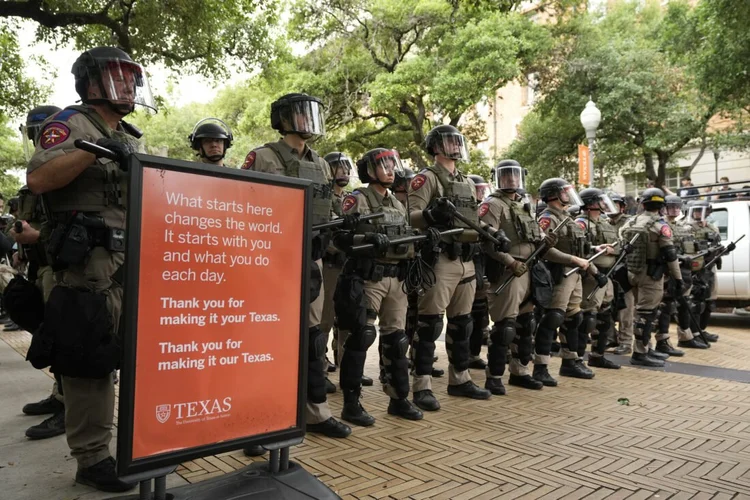
San Francisco State University has begun divesting from weapons manufacturers sending arms to ‘Israel,’ marking a major win for the movement for Palestinian liberation. Over the summer, a working group consisting of students, faculty, and admin examined the school’s investment policies and outlined a process for divestment. Administrators at other schools used the summer quite differently, devising new strategies to curb pro-Palestine protest under the guise of “protecting safety” and the “healthy exchange of ideas.” California State University and the University of California, two of the largest public university systems in the U.S., released a bundle of new rules banning “overnight demonstrations” and “unauthorized structures.” Students at the University of South Florida are now required to get prior approval for any activity that may feature signs, tents, or amplified sound. At the University of Michigan last week, police violently attacked student protesters for “blocking traffic.” Columbia University, under pressure from a congressional subpoena, is foregoing due process for students arrested last semester, fast-tracking their cases to disciplinary hearings where they can be expelled or otherwise punished. The most egregious measure came down from New York University, where new guidelines around hate speech and harassment identify Zionists as a “protected class” that must be shielded from “adverse treatment.” The school said its new policy falls under its implementation of Title VI of the 1964 Civil Rights Act Historically, organizers have deployed the statute to fight housing discrimination or environmental racism, but now, NYU administrators are weaponizing the law to protect students supporting a genocide. In the face of such viciousness, students refuse to let up their fight. Palestine has exposed the contradictions of campus life, the limits of the liberal imaginary, the faux promise of “free speech.” As the students set up pickets and take the streets, the quads — we will meet them there.
|
Pack the courts, take the streets
|
|
By the time police dismantled the last encampments this past June, over 3,100 students had been arrested across 109 colleges in 39 states. Unlike comrades picked up for actions on highways or at weapons manufacturers, these students face a bifurcated system of penalization, subjected to the legal cruelties of their municipal courts and to the extralegal discipline of their universities. Criminal records, hefty fees, and days in jail await many arrestees, as do academic probations, suspensions, and expulsions. Universities have banked on summer’s amnesia to pacify students and donors; but, as the fall term commences, schools have only escalated their policing and repression. In mid August, NYPD arrested a student at a picket line against suspensions at Barnard’s move-in day, and earlier this week, the cops brutalized Columbia student protesters for offenses such as as touching a police barricade. Our fall is punctuated by court dates. On September 5th, 8 of the “CUNY 28” head to court on felony charges in New York; on the 11th, 14 at Princeton are arraigned for the 4th on charges of civil disobedience; and in late October 44 Yale affiliates appear at a hearing to drop the charges in Superior Court. The strategy here is obvious: universities use their local courts to set the newfangled precedent that students can “trespass” on their own campuses, while, at their home base they arrogate good conduct through severe penalties. The counter-strategy, a continuation from last spring, is also obvious: to assume risk, to pack the courts, to make these campus enclosures public and free. If they take us to court, we take to the streets.
|
|
April’s encampments were immediately recognizable as a historical rupture — and, like most such ruptures, they were achieved by people who knew their histories. Student organizers took careful notes on the solidarities, ideologies, aesthetics, and tactics from previous eras of student struggle, looking, in particular, at anti-Vietnam War protests in the late 1960s and the push for divestment from South Africa in the 1980s. It was easy homework, in large part because the documentation of prior struggle had been so well preserved in the archives and libraries of the universities they were protesting anew. In May, an archivist for Columbia’s Rare Book & Manuscript Library (RBML) went through their Gaza Solidarity Encampment and seized materials from the recently swept site to preserve for the school’s “institutional memory.” (By waiting until after the sweep, the archivist was working hand-in-glove with the police.) While the RBML returned materials “for collection from students” after members of Columbia University Apartheid Divest raised concerns, their intentions were clear: to become the curator of this radical history, to pacify it, defang it, and deliver its bloodless shadow back to new cohorts of students. Student organizers devised their own archival practices, allowing the documentation of their struggle to be preserved for present and future publics without becoming privatized at the enemy’s hands. Students at Princeton gave oral histories to the Ida B. Wells Just Data Lab, which, while funded by the university, houses its own servers and has jurisdiction over all its collected materials. Meanwhile, organizers at the University of North Carolina built up encrypted drives for record keeping and recorded histories throughout the encampment so as to not reduplicate efforts the next time around and provide ongoing context for new students. In this diversity of practice, there is a shared sensibility: we cannot allow our strife to be curated by the university’s neutralizing apparatus.The university hoards information; the encampments reclaim and collectivize it.
|
|
If you’re a student, consider joining your campus chapter of Students for Justice in Palestine, or forming one of your own. If you’re faculty, read “So You’re a Professor? Here’s What You Can Do to Oppose Genocide” by Steven Salaita and consider how you fit into the struggle at your institution. Alumni can consider withholding donations from their schools and donating to anti-imperialist cultural organizations or direct/mutual aid for Palestinians instead. If you’re a unionized graduate worker, encourage your union to pursue a divestment policy or make a statement in solidarity with Palestine.
|
|
Our communications committee is reading Mahdi Amel’s essays, Joy James’s In Pursuit of Revolutionary Love, a new takedown of American empire by Steven Salaita, a new takedown of Joshua Leifer by Charlotte E. Rosen, and Kwame Nkrumah’s essential Handbook of Revolutionary Warfare. Our popular education committee is reading Reese Simoneau’s paper on the recuperation and co-optation of the Black Lives Matter protests, Joshua Bloom and Waloo E. Martin Jr.’s 2013 history of the Black Panther Party, Black Against Empire, Don DeLillo’s novel Mao II, and Abigail Susik’s interview with Ben Morea (“we wanted to destroy the university,” Morea says). Our labor committee is reading Pinko Mag’s Queer Palestine, Immanuel Wallerstein’s Historical Capitalism: With Capitalist Civilization, and Joyful Militancy by Carla Bergman and Nick Montgomery. Our Los Angeles chapter is reading Harry Harootunian’s The Unspoken as Heritage: The Armenian Genocide and Its Unaccounted Lives, Ursula K. LeGuin’s The Dispossessed, Aruna D’Souza’s Imperfect Solidarities, Robin Wall Kimmerer’s Braiding Sweetgrass, and Beatrice Adler-Bolton and Artie Vierkant’s Health Communism. They are also reading Theia Chatelle’s article on how ‘Israel’ targets and blackmails queer Palestinians.
Our Philly chapter is reading “Intifada: On Being an Arabic Literature Professor in a Time of Genocide” by Huda Fakhreddine, In the Crossfire: Adventures of a Vietnamese Revolutionary by Ngo Van, Heartbeat of Struggle: The Revolutionary Life of Yuri Kochiyama by Diane Fujino, and Knights of Cinema: The Story of the Palestine Film Unit by Khadijeh Habashneh. Our Toronto chapter is reading “Linguistics for Liberation or for Domination?: The battle at MIT over a linguistics course on Haiti, Palestine, Israel and the war on Gaza” by Michel DeGraff, “Why Did Canada’s Top Art Gallery Push Out a Visionary Curator?” by Jason McBride, and Radical Philosophy’s “Palestine” issue.
|
|
We leave you with the words of the scholar Nasser Abourahme: “Palestine … is the living archive of our future. But it is also the name of a renewed planetary consciousness. It has been the cause for the largest global student movement in generations, the biggest manifestations of left internationalism the west has seen in decades, and probably the largest mobilisations of Jewish anti-Zionist activism America has ever seen. These gains have not been won despite Palestine’s war of liberation but because of it; without the challenge of Palestine’s anticolonialism, without the ability to upend the colonial logic of rule and refuse the entire imperial arrangement, all of this would be a moot point. None of the diplomatic, legal or ideological gains would have been made without the armed struggle ensuring there was still something on the ground worth fighting for.”
|
Until liberation,W.A.W.O.G.Twitter: @wawog_now Instagram: @wawog_now For press inquiries: press@wawog.com For general inquiries: wawog@wawog.com Was this email forwarded to you? Sign up to receive it here.
|
|
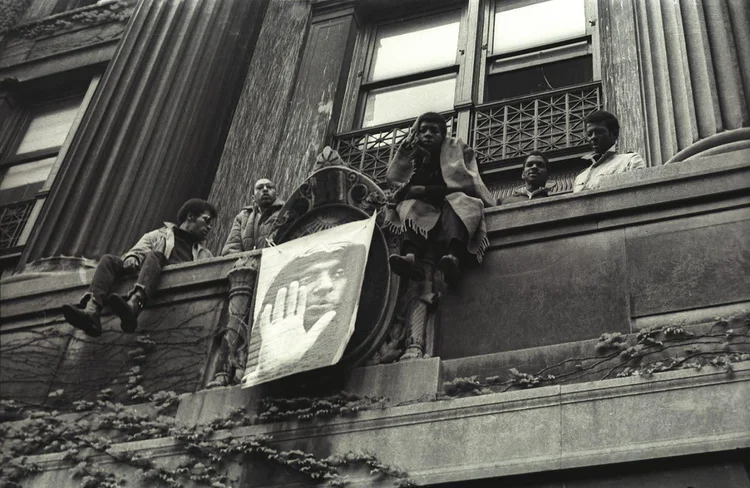
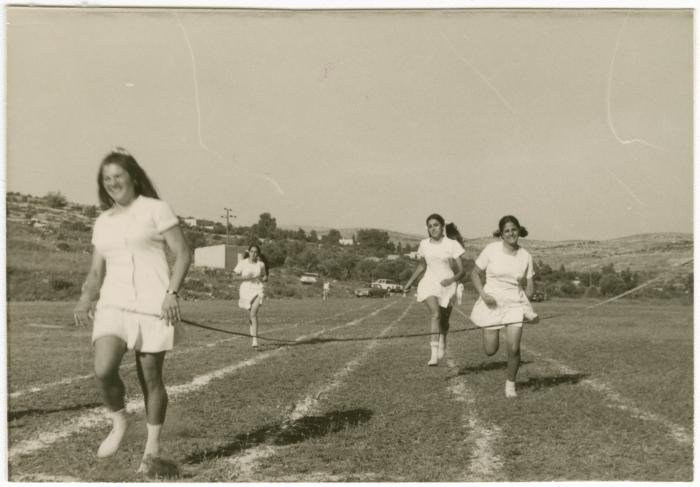
IMAGE CREDITS: 1) The 1968 occupation of Hamilton Hall by Peter Chartrand 2) State troopers at the University of Austin encampment, source unknown 3) A student at Birzeit University wears a scarf of the Islamic resistance during students council elections in 1992, Joss Dray 4) Students wear the badges of their political movements during the student council elections at Birzeit University in 1992, Joss Dray 5) A group of Birzeit College students participate in the athletics festival organized by the College in 1972, Palestine Museum Digital Archive 6) School kids during the First Intifada, source unknown.
|
|
|
|